Big Personality, Small Closet: The Art of Dressing Like Yourself With Less
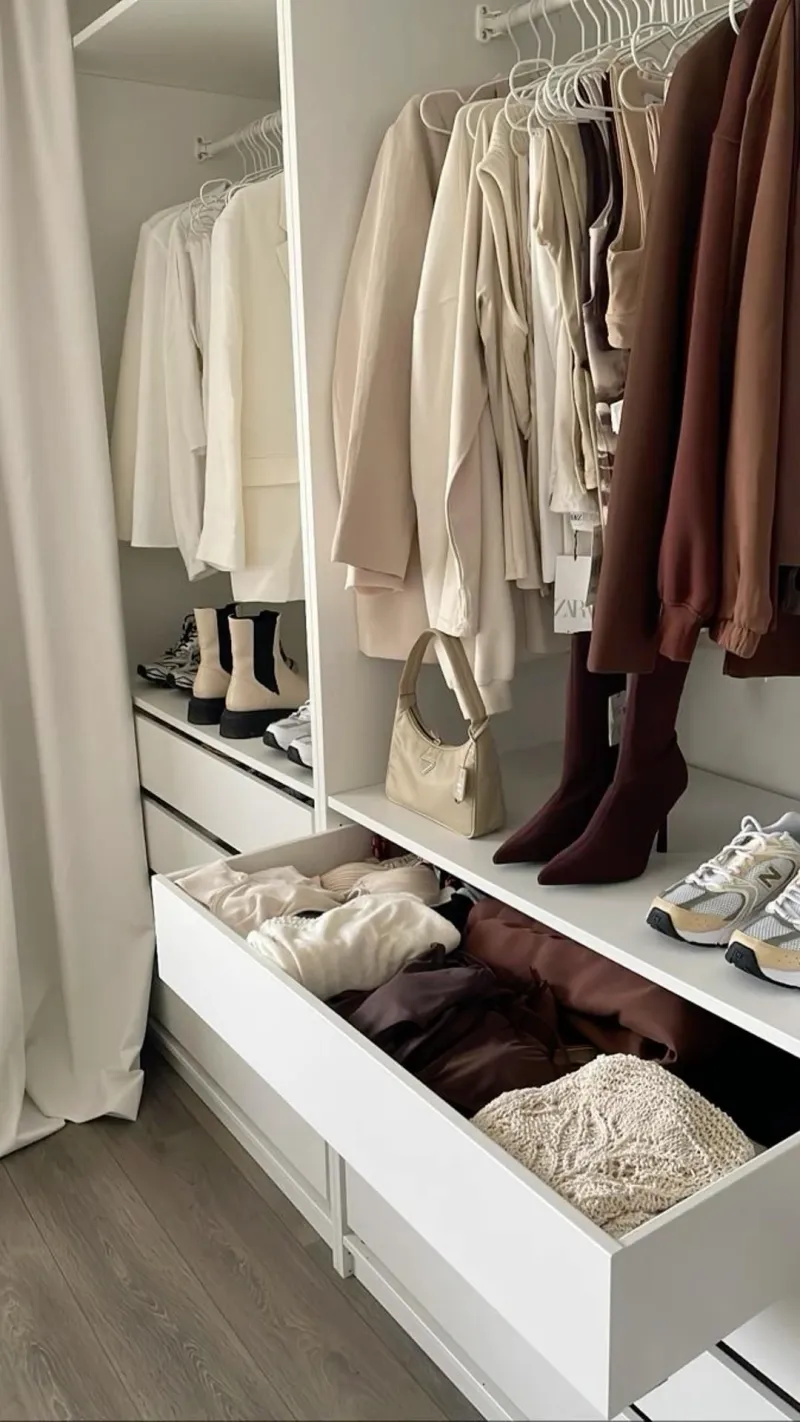
Photo: stylish woman curated minimal colorful wardrobe open closet, via i.pinimg.com
Somewhere between the perfectly curated beige wardrobe and the overflowing closet that takes twenty minutes to navigate, there's a sweet spot. It doesn't have a single rulebook, and it definitely doesn't look the same on everyone. But people who've found it? They'll tell you getting dressed has never felt so effortless — or so them.
Call it the minimalist maximist approach. It's the idea that you don't need more clothes to express more of yourself. You just need the right clothes, chosen with a little more intention.
Where Did This Come From?
For the past few years, American fashion culture has been pulled in two very loud directions. On one side, quiet luxury — muted palettes, understated tailoring, the whole "old money" aesthetic that flooded social media feeds. On the other, maximalism: clashing prints, layered jewelry, dopamine dressing in its most joyful form.
Both trends have had their moment. Both have real merit. But a lot of people found themselves somewhere in the middle, not quite satisfied by either extreme. The all-neutral wardrobe felt like it was erasing something. The anything-goes maximalist approach felt exhausting to maintain — and expensive.
"I kept buying things that were 'supposed' to go together, but I'd get dressed and feel like I was wearing a costume," says Maya, a 31-year-old graphic designer from Austin, Texas. "I finally realized I needed fewer pieces that actually felt like me, not more pieces that just coordinated."
That realization is exactly what stylists and fashion psychologists have been pointing toward for a while now.
What Fashion Psychologists Are Saying
The relationship between clothing and identity isn't shallow — it's deeply studied. Fashion psychologists have long argued that what we wear functions as a form of nonverbal communication, signaling our values, moods, and group affiliations to the world before we say a single word.
The problem with an overstuffed closet, according to this line of thinking, isn't just practical. It's psychological. Too many options can dilute your sense of self rather than amplify it. When you're choosing between 60 tops every morning, the decision fatigue is real — and so is the disconnection from what actually resonates with you.
A smaller, more intentional wardrobe forces a kind of self-editing that ends up being clarifying. You start to ask better questions: Does this actually reflect who I am? Does this feel like me on a good day? Those questions have a way of cutting through a lot of noise.
Building a "Personality-First" Closet
So how do you actually do this? It's less about following a formula and more about getting honest with yourself — but a few practical frameworks can help.
Start with your "signature moves." Think about the three or four style elements that consistently show up when you feel most yourself. Maybe it's a bold lip paired with something structured. Maybe it's always having a little texture in the mix. Maybe it's a specific color that just works for you. These aren't trends — they're your personal constants. Build around them.
Audit for personality, not just versatility. Most wardrobe advice tells you to ask "does this go with everything?" That's useful, but it's not the whole story. A piece can be versatile and have a strong point of view. In fact, the most interesting wardrobes are built on pieces that do both. That cobalt blue structured blazer might not go with literally everything, but if it goes with enough — and it makes you feel like you walked out of a fashion editorial — it's earning its place.
Think in "character clusters" rather than outfits. Instead of planning outfits, some stylists recommend thinking about the different "characters" or modes you move through in a week — the professional version of you, the weekend version, the going-out version. Build a small, cohesive cluster of pieces for each mode, making sure each cluster feels distinct but connected to your larger aesthetic identity.
Give yourself one "wildcard" per cluster. This is where the maximist part comes in. Within each cluster, allow one piece that's a little louder, a little more unexpected — something that injects genuine personality into even the most practical outfit. A printed scarf. An architectural bag. A pair of earrings that could start a conversation. These wildcards are what keep a small wardrobe from feeling flat.
Global Style, Personal Identity
One of the most exciting things happening in American fashion right now is how global influences are feeding into this personality-first approach. The minimalist maximist aesthetic doesn't have a single cultural origin — it draws freely from the clean lines of Scandinavian design, the bold color confidence of West African fashion, the artful layering traditions of Japanese street style, the expressive tailoring you see across Latin American fashion capitals.
The result is a wardrobe that feels genuinely personal because it is genuinely personal — assembled from influences that resonate with you specifically, not just whatever's trending on your algorithm this week.
Jordan, a 27-year-old teacher from Chicago, describes his approach this way: "I have maybe 35 pieces total, but they pull from so many different places. I've got a really structured Korean-inspired jacket, some vintage American workwear basics, a couple of pieces with West African print details. It sounds like it shouldn't work, but it does because I connect all of it. It's my story."
The Practical Upside
Beyond the philosophical, there are real, tangible benefits to this approach. A smaller wardrobe is easier to maintain, easier to pack (a huge win for anyone who travels), and — done right — actually saves money in the long run. You're buying less frequently, but buying more deliberately. The cost-per-wear math tends to work out in your favor when every piece is genuinely loved.
There's also a sustainability angle worth naming. The fashion industry's environmental footprint is well-documented, and buying less is one of the most direct ways consumers can reduce their individual impact. The minimalist maximist approach aligns naturally with a more conscious consumption mindset — not because it's preachy about it, but because intentionality and sustainability tend to travel together.
The Bottom Line
You don't have to choose between expressing yourself and keeping things simple. The most interesting wardrobes aren't the biggest ones — they're the ones that feel most alive, most coherent, most like the person wearing them.
The minimalist maximist approach isn't a rigid system. It's more of a mindset shift: away from accumulation, toward curation. Away from "what goes with what," toward "what feels like me." It's a small adjustment in how you think about clothes that can make a surprisingly big difference in how you feel every single morning.
And honestly? That's what style has always been about.